Evolution of Dynasty Wealth,
Wealth Builder and digital VC industry, May 31, 2019
By Michael Markowski – May 31, 2019
My research on the SEC’s new regulations and securities laws which came into effect during the Obama Presidency led to the following:
- Development of the first digital venture capital (digital VC) model.
- Discovery of the digital VC industry, a serious disruptor to the traditional VC and investment banking industries.
- Creation of hybrid wealth management products, the first to incorporate venture capital investments in managed portfolios.
A digital VC is a magnet to attract the $88 trillion of capital that is managed by global investment managers. The digital VC’s utilization of algorithms to produce superior returns from the trading of ETFs, index funds and currencies provides it with a steadily growing base of discretionary venture capital. The digital VC has the ability to drive a portion of non-accredited and accredited investor assets and algorithm trading profits into startups and to provide their shareholders secondary market liquidity. In developing the model and products for the first digital VC, Dynasty Wealth from 2014 to 2019, I was able to identify several other digital VC niches and variations to the model.
With several digital VCs on the white board and no competitors emerging, my efforts quickly went from that of an entrepreneur building a company to a visionary building an industry. Since the digital VC industry has similar demographics to Social Media, the new industry will rank among the world’s ten most profitable and valuable by 2030.
To lay the foundation for the industry, which had been originally named the Social Investing Communities industry, required the adoption of the strategy used by Alfred Sloan, President of General Motors (GM), during the 1930’s and 40’s to overtake Ford Motor. Under Sloan, GM leveraged its automobile engines and chassis to create and market multiple automobile brands at differing prices to appeal to varying demographic groups. This tactic enabled Sloan to usurp Henry Ford, who was famous for saying “any color as long as it is black”.
The digital VC industry which has emerged features six digital VCs. Each address different demographics and niches. The wealth management products for each of the digital VCs that have been conceived are powered by the same algorithm. Unlike Sloan’s model, each of the digital VCs is a separate legal entity operating autonomously given that the financial services industry is highly regulated.
To build the industry required that a private capital markets eco-system (PCME) be developed. For more information about the PCME and the digital VCs view video of my keynote address at a startups conference.
Below is the outline of the history of the digital VC industry which began to evolve after the SEC released its new regulations and securities laws which pertained to the Dodd Frank and the JOBS Acts.
- Need for Digital VC (former name social investing communities) industry discovered
- View 6:40 sec. video
- Read “Crowdfunding Must Get Back to Its Roots” article.
- First six digital VCs identified in 2014
Click here for list
- Need for Private Capital Markets Eco-system (PCME) emerges
- View 9:06 sec. video
- Also, read article “Dodd Frank: Boon for Large Caps, Bust for Micro-caps”
- Evolution of Digital Business Development ecosystem (DBDE) which began in 1959
- View 3:27 sec. video
- Bull & Bear Tracker (BBT) algorithm and its derivatives which power the wealth management products was initially developed in 2016 to predict stock market crashes. BBT predicted the June 2016 Brexit crash and was mothballed after President Trump was elected. It was brought out of retirement and converted to a trend trader in April 2018. For the April 9, 2018, through May 31, 2019 period which the signals were published the return was 28% versus a 5.3% return for S&P 500.
- First four digital VC’s have published startups recommendations Track records which can be used for marketing claims.
- First Wealth Management product, Wealth Builder (algorithm/startups hybrid) developed in 2018
- Link to Kuvera Wealth Builder product offering page
8. BBT algorithm signal strength measurement system developed from March 2019 through May 2019. Based on back testing, the returns for the BBT are projected to increase by 100% to 200%.
Dynasty Wealth and the other affiliated digital VCs, in which it has a significant stake, are robo investment managers. The digital VCs utilize proprietary algorithms and startups to maximize performance for their unaccredited and accredited investor clients.
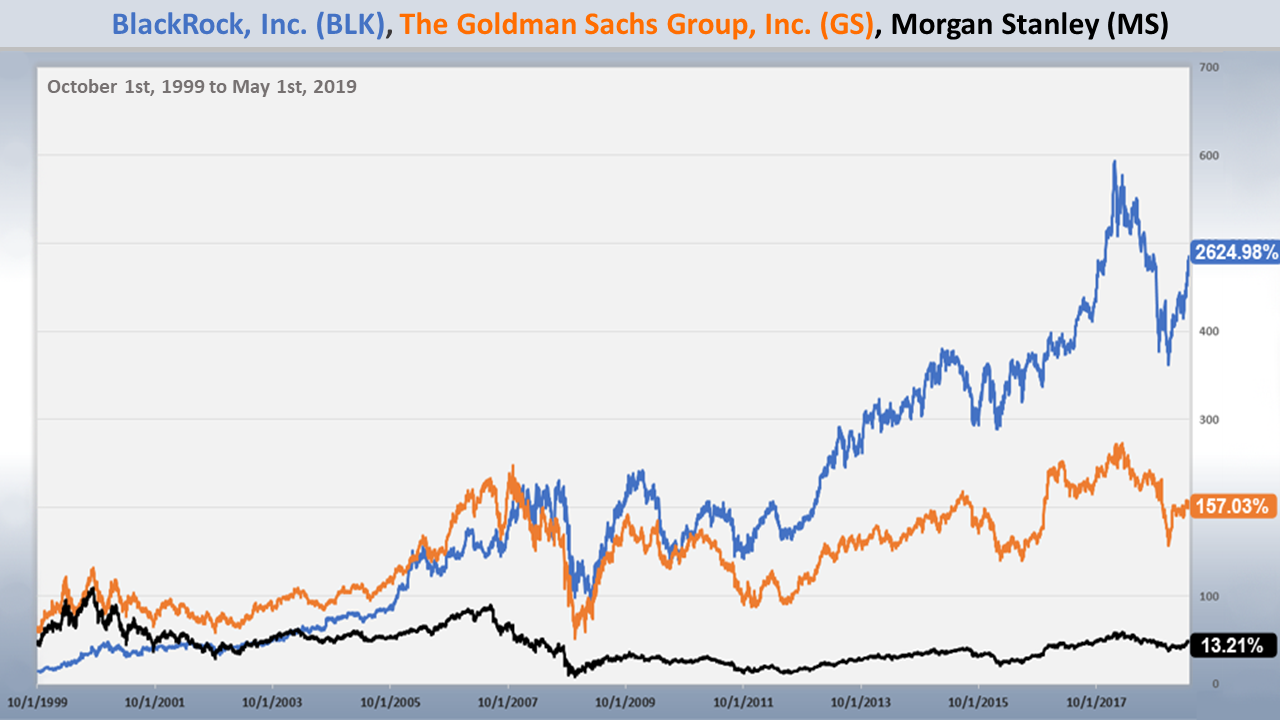
Publicly traded Black Rock (NYSE:BLK) with a recent market cap of $65 billion is best used to describe the upside for the digital VC model and the digital VC industry. BlackRock has been a leading innovator in the financial services industry. It’s a leading developer and manager of ETFs and also utilizes publicly traded and private equity investments to manage the assets of its institutional and high net worth individual clients.
Blackrock was founded in 1988 and launched its initial public offering at $14.00 per share, valuing the master limited partnership for $2.12 billion on October 1, 1999. Since then its shares have substantially outperformed traditional brokers including Goldman Sachs and Morgan Stanley. The chart below depicts that BlackRock shares increased by 2,625% as compared to increases of 157% and 13.2% for Goldman Sachs and Morgan Stanley shares from October 1, 1999 through May 1, 2019.